
How to build a collection route that actually fits in one day
A route is not lost to laziness. It is lost to order: crossing the city twice, reaching the market after the trader has closed, and getting home to add up in a notebook what should have been recorded at the customer’s door.
You will not find route theory here. You will find the four decisions a collector makes to build the day: how many visits fit, how much should come in, what to do about the person who is out, and how to balance the cash on return.
Build my route free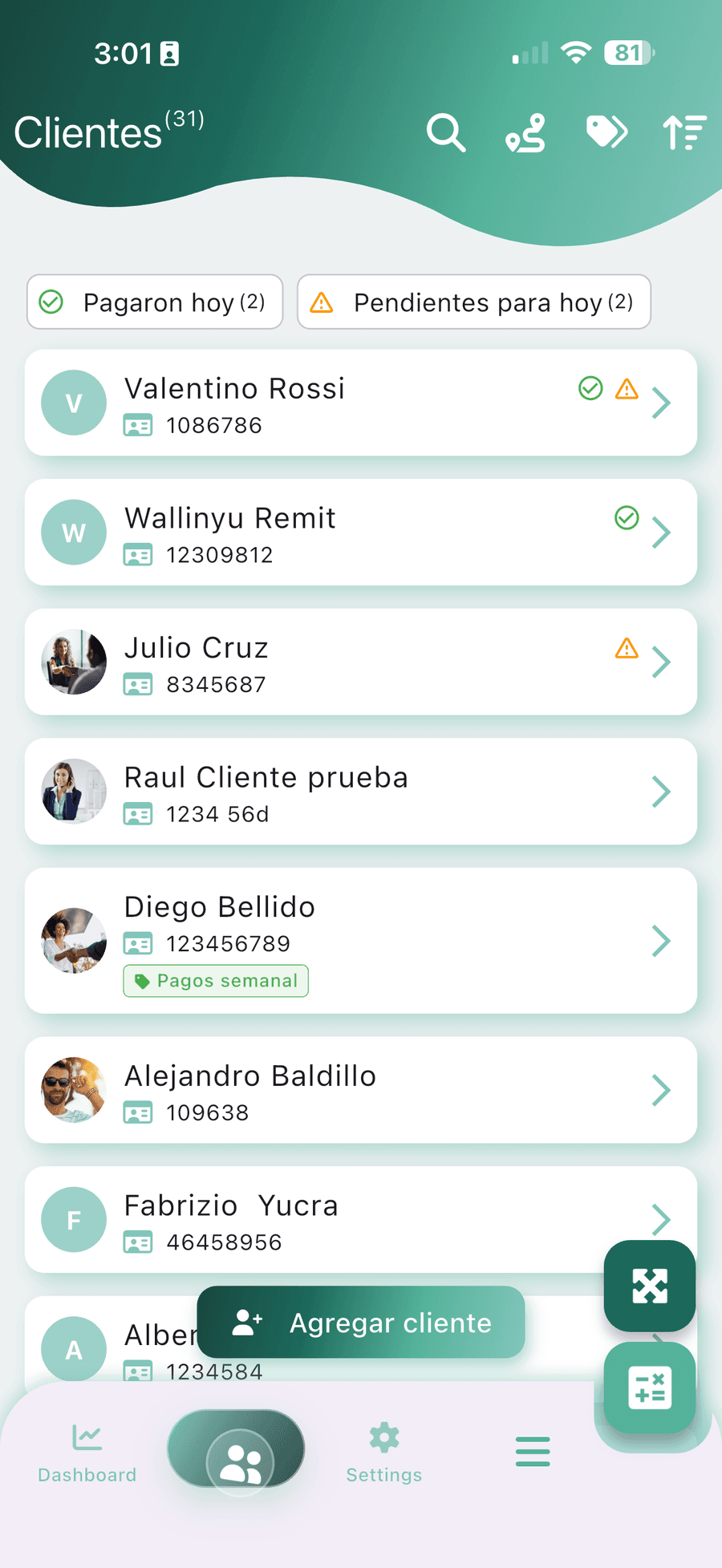
How many visits fit in a day
The ceiling of a route is not set by the collector: it is set by the distance between doors. A visit costs two things: the exchange with the customer (greeting, taking payment, handing over the receipt) and the travel to the next house. Time both for a week and you have your number, which need not look like anyone else’s. The minutes in the table are a sample: they are there to show the arithmetic, not to be copied. Swap in your own and the result changes with you.
| Type of area | At the door | Travel | Total | Visits per day |
|---|---|---|---|---|
| Compact area (market, arcade, one block) | 5 min | 2 min | 7 min | 77 |
| Residential neighborhood with detached houses | 4 min | 6 min | 10 min | 54 |
| Spread-out or rural area, by motorbike | 4 min | 12 min | 16 min | 33 |
That last number is the theoretical ceiling and it is never met, because you have to subtract the return visits. Follow the arithmetic with the example: if one in five customers is out and going back costs you 6 minutes, a route of 45 visits carries 9 return trips, that is 54 minutes more. That is why a route is always planned below the ceiling: with these sample times, around 40 to 45 customers instead of the 54 the table gave. The difference between the two numbers is exactly what time you get home.
The sheet for a 45-customer route
This is what a sample route looks like when it is built by area rather than alphabetically. Each area has its time window, and the clock decides the order before the map does: the market first, where the trader has cash from early on; the neighborhood that only takes money after lunch, last.
| Area | Customers | Window | Minutes | Expected |
|---|---|---|---|---|
| Market square | 14 | 7:00 – 8:40 | 100 | $ 620 |
| Downtown | 12 | 8:50 – 10:50 | 120 | $ 500 |
| Ring road | 11 | 11:00 – 13:00 | 120 | $ 410 |
| Villa Nueva | 8 | 14:00 – 15:40 | 100 | $ 270 |
| Total | 45 | 7:00 – 15:40 | 440 | $ 1,800 |
The 440 minutes are visits only. Between areas there is travel and in the middle there is lunch: that is why the day starts at 7:00 and closes at 15:40. And the $1,800 is not what you will collect, it is what should come in if everyone pays. If at the close of this sample day $1,520 came in against the $1,800 expected, collection effectiveness was 84%. Write that percentage down every day and after a month you will have something no hunch gives you: which areas perform and which do not. Careful how you read it: it is the percentage of the money, not of the visits. You can collect from almost everyone and still fall short because the customer with the biggest installment was missing, so it is worth recording both separately.
The customer who is out: the hole that sinks the route
An absent customer costs more than the installment they did not pay, because it breaks the order of the route. The temptation is to go back right away; the discipline is not to. These four rules are what separate a route you finish from one that falls apart by mid-morning.
Record the visit even with no money
A visit with no payment, with the reason. If you leave the field blank, by the evening you will not be able to tell who did not pay from who was not visited. And that doubt turns into arrears.
Go back when the area is finished
Never double back in the moment. Carry on until the area is done and revisit those who were out before you leave it. Crossing the city to pick up a single installment almost never pays for the journey.
A promise has a date and a time
“I’ll pay you tomorrow” is not data. “Tomorrow at 6 p.m.” is, because it changes the order of Wednesday’s route. Record the promised time, not the promise.
Two misses in a row change the treatment
When the same customer fails twice in a row it stops being a route problem and becomes arrears management, with a call and an agreement before you pass by again. Knocking on the same door at the same hour only burns fuel.
That visit history is what later lets you argue with data. If you need the script for the difficult conversation, it is in the guide on how to collect from late-paying customers, and the full theory of areas and time windows is in how to plan collection routes.
Splitting the street between several collectors
There is only one rule: you split whole areas, never individual customers. The moment two collectors have customers on the same block, both spend the same travel time and neither is responsible for that area.
Each team member signs in with their own user and works the customers of the areas you assigned, not the whole portfolio. You are the one who sees the consolidated view: how much each has collected and what is left to visit.
When someone is absent, the whole area moves to another collector for that day. Moving customers one by one always ends with two or three forgotten, and those are exactly the ones who fall behind.
With several collectors the close stops being a sum and becomes a comparison: each area’s expected figure against what each person handed in. When an area falls below its own average two weeks running, before blaming the collector it is worth looking at the hour: often the visits are happening before people have taken any money.
What the app does not do yet: it does not track the collector’s route on a map. Location supervision is in development. What you do get today is every payment recorded with its date and time, which is what shows whether an area is being collected at 7 in the morning or at 4 in the afternoon.
If you are building the team from scratch, the debt collection app explains how a payment is recorded at the customer’s door and how the receipt is printed.
Closing the cash: three figures, in this order
Closing is not adding up notes. It is comparing three figures that have to tell the same story. When two do not match, the difference tells you exactly where the problem is — and it is not the same problem in each case.
-
Expected
$ 1,800
The sum of the installments due today, including what the late payers carry over. You know it before leaving the house, not after.
Tuesday · 45 customers
-
Collected
$ 1,520
The sum of the payments you recorded on the street. Against the expected figure it gives your effectiveness for the day. If it drops, the problem is the route or the hour.
84% effectiveness
-
Handed in
$ 1,520
The cash that reaches the office. Against the collected figure there should be no difference. If there is, it is a cash problem, not a collections one.
Equal to collected
The reconciliation only holds if the payment is recorded at the customer’s door and not from memory at the end of the day. That is the whole trick. To see how the capital on the street looks once the day is closed, look at daily loan tracking; and if you run several routes from the office, the collections platform brings them all together in one dashboard, from the computer too.
Moving your route from the notebook to the app
You do not need to migrate the whole portfolio at once. Start with one area: register its customers with address and landmark, create the route and work it for a week with the app and the notebook side by side. At the end of the week you will have both reconciliations next to each other and can decide with your own numbers, not a brochure’s.
The free plan allows up to 10 customers and 2 loans per customer, enough to test the round with real customers without paying anything. When you want to move up the rest of the portfolio or add collectors, the details are on plans and pricing.
The route works with no signal, so an area without coverage stops being an excuse to write on paper. And the receipt prints on the spot on a 58 or 80 mm Bluetooth printer, so the customer keeps their proof at the door and you keep the payment already recorded.
If you would rather see first how a whole day looks for a collector working daily-payment loans, start with what a daily-payment loan is and how it works.
Frequently asked questions about the collection route
What people who have to go out collecting tomorrow ask about organizing the day.
Does CobrApp handle collection routes with GPS?
How many customers really fit on a one-day route?
Does CobrApp build the route on its own, or do I order it?
What do I do about the customer who was out when I came by?
Can I split one portfolio between several collectors?
Does the route work if there is no signal in the area?
How do I balance the cash when the route is done?
$ 3,470.00 Balanced
What a route of 37 visits with 4 collectors brings in on one day, with the portfolio balanced at close.
Build your first route tonight
Register one area, order the visits and head out tomorrow with the list ready. Free, no card.
CobrApp does not grant credit or lend money. It is a technology platform for collections management and portfolio control of loans issued by third parties.