
The collections app for people who lend and collect in Mexico
Weekly and biweekly payments in pesos, routes by colonia, a receipt printed on the spot and recording with no signal. CobrApp replaces the notebook you carry out every day.
COBRAPP
Payment receipt
Printed over Bluetooth
Not every collection there is daily: people also pay weekly and every fortnight
Much of the Mexican calendar moves on the fortnight. Whoever is paid on the 15th and the last day of the month gets their wages then, and the collector fits the round to that date because afterwards the money has already moved. The market-stall trader prefers to pay on a day sales went well. The one with a fixed stall in the market can pay daily. There is no single frequency, and that is exactly what a notebook handles badly.
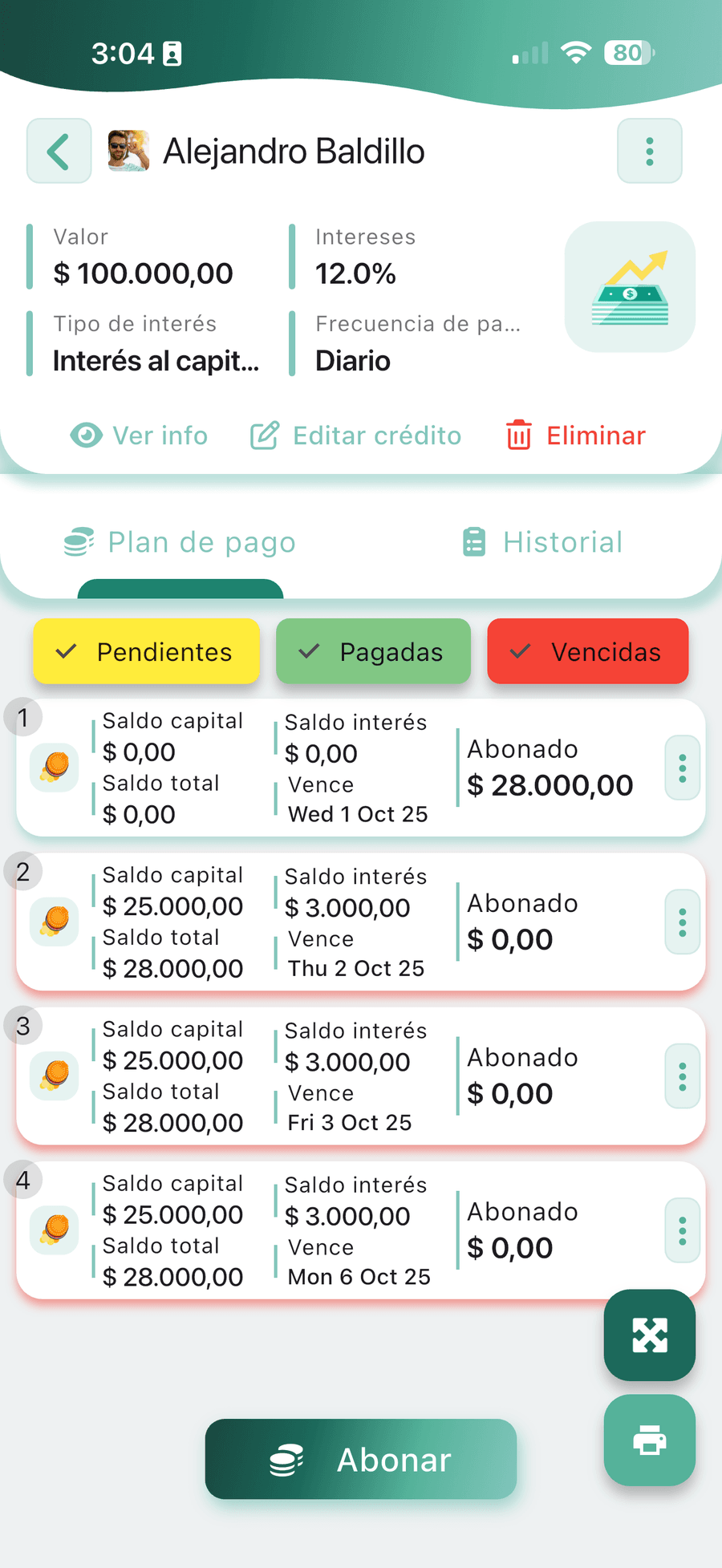
That is why the first thing you choose when creating a loan in CobrApp is the frequency — daily, weekly, every fortnight, biweekly or monthly. With it the app builds the calendar and works out the exact payment for each date, and customers on different frequencies live in the same account. When a payment date passes without a record, the customer is flagged as behind without you having to check.
The other Mexican detail is the vocabulary. There people do not say “installment”, they say abonar. They do not say close, they say corte de caja. And the customer does not live in a neighborhood: they live in a colonia, sometimes in a house with no number, “the one with the green gate next to the tortilla shop”.
CobrApp keeps that landmark with the address and groups customers by colonia, so the day’s collection route orders itself instead of being rebuilt from memory every morning.
Daily
Weekly
Every fortnight
Biweekly
Monthly
Get out the calculator and check the numbers
These three rows are pure arithmetic: put in your own numbers and the result works the same way. The percentages are from the example, not a suggested tariff or a reference for what the market charges: you decide the rate and the app only does the arithmetic. It is exactly what it resolves when the loan is created, before you go out on the street.
| Frequency | Example customer | Amount | Term | Example interest | Total to repay | Payment |
|---|---|---|---|---|---|---|
| Weekly | Street-market stall | $6,000 | 12 weeks | 20% | $7,200 | $600 |
| Biweekly | Paid on the 15th and the 30th | $10,000 | 8 fortnights | 30% | $13,000 | $1,625 |
| Daily | Fixed stall in the market | $3,000 | 24 working days | 20% | $3,600 | $150 |
The first row, step by step: $6,000 times 1.20 is $7,200; over 12 weeks, $600 per payment. The second: $10,000 times 1.30 is $13,000; over 8 fortnights, $1,625. No app should ask you to trust a number you cannot redo by hand.
What the app does save you is the repeated work: when the customer pays more or less, recalculating the balance, shifting the dates and knowing how many payments are left. If you work with interest on the balance rather than a fixed figure, look at how the daily interest calculation is built.
A small detail that is appreciated at the door: figures are written the way they are written there, with a comma for thousands and a dot for decimals. One thousand six hundred and twenty-five pesos read $1,625, so the customer understands their receipt at a glance instead of handing it back with a question.
On screen, each customer shows three things and nothing else: how much they owe, when the last payment was, and how many days they are behind. That is the order that decides who to visit first when the route is long and the day is short. And if your business has already moved from the notebook to a file with formulas, the honest comparison is in our Excel versus collections app comparison.
What you say on the route, where it lives in the app
Nobody should have to learn a new language to use a work tool. This is the direct translation between the notebook and CobrApp.
| On the street people say | In CobrApp it is |
|---|---|
| “They already paid me” | Payment recorded in three taps, with date, time and new balance |
| “Pull up their file” | Customer history: loans, payments and days behind |
| “The Guerrero route” | Collection route grouped by colonia, with the visit order |
| “Let’s do the cash close” | The day’s report: collected, pending and difference per collector |
| “That one is behind already” | The customer is flagged as behind as soon as the payment date passes |
| “Give me my receipt” | Proof printed over Bluetooth (58 and 80 mm) or shared as a PDF |
| “How much do I have out there?” | Portfolio: capital placed, balance receivable and accumulated arrears |
| “The kid on the route” | A collector with their own login, limited to the area you assigned |
Who uses it in Mexico
Mexican popular credit does not have one single face. CobrApp adapts to the structure you work from, not the other way round.
Independent lender
You place your own capital in your colonia and keep everything in a notebook. Here every payment comes with its proof.
Collector or route team
One or several collectors on the street. Each records from their own phone and you see the progress without calling them.
Savings cooperative
Individual control of each member’s credit, with a statement and Excel export for the administration.
SOFOM and microfinance institution
The portfolio placed in the field, by officer and by area, recorded on the same day it is collected.
A shop that sells on credit
Groceries, furniture, clothing: who owes, since when, and how much they have paid.
Whoever collects a bit of everything
Daily, weekly, fortnightly, biweekly and monthly all live in the same account, with no second notebook.
CobrApp does not grant credit or lend money. It is a technology platform for collections management and portfolio control of loans issued by third parties. For the accounting, tax or regulatory obligations that apply to your structure in Mexico, consult your accountant or legal adviser.
Five things the colonia teaches you the hard way
The signal drops exactly where the customer is. In the market corridors, inside a tenement, on the second floor of a shop. And some collectors run out of data halfway through the month. That is why the recording has to be resolved inside the phone: you take the payment, print, and keep walking, and the upload to the cloud handles itself later without anyone pressing a button.
The receipt is not for you, it is for the customer. Whoever pays wants to see in writing what they handed over and what is left, and often that is checked at home by somebody else: the son, the spouse, the stall partner. Proof printed on the spot works as a statement for the whole family. The app sends it to a portable thermal printer over Bluetooth — the 58 or 80 mm kind sold in the electronics markets — and if you did not charge it that day, you share the same proof as a PDF from the phone.
The fortnight falls on a Sunday. Or on a long weekend, or a public holiday. The payment calendar has to be able to shift without dismantling the whole loan or redoing everyone’s arithmetic.
The cash close happens at night, when you are tired. That is when the addition errors happen. If every payment was recorded at the moment of collection, the close stops being an arithmetic session and becomes a comparison: what the report says against the cash each collector brings in.
When the kid on the route changes, the memory goes with them. You do not just lose the person: you lose knowing who owes what, which customer opens the stall early and which does not show up until the afternoon. If the customers and the payments already live in the business account, handing the area to the new arrival means opening their login and assigning it. That team control is the same one we explain in the debt collection app.
Growth hurts in the paperwork, not on the street. Adding a second route does not change the work of collecting; it changes the work of controlling. When that point arrives, the collections platform centralizes every route’s portfolio in one dashboard, and the loan management software gives you the detail of each loan placed.
LA GUERRERO ROUTE
15/09/2026
PAYMENT RECEIPT
CUSTOMER
Lourdes Hernández
LOAN DETAILS
THIS PAYMENT
Thank you for your payment
Paid
Printed with no internet · 80 mm
Do you want the product or the guide?
-
This is the product page: what the app does, which frequencies it works in and what a payment recorded on the street looks like. If what you want is the wider picture first — what to check before choosing a tool, which popular credit models exist and how to migrate without losing the portfolio — the long read is the guide to the collections app in Mexico.
-
And if you sell on credit in a shop rather than lending money, the control is similar but the flow changes: that is in how to keep track of your shop’s credit.
-
The trade does not change across the border, but the words and the currency do. If you also operate outside Mexico, you can see how the same tool is framed for daily collections in Colombia, where the count is in working days and the loan is called gota a gota.
-
To start today you do not have to decide anything: download the app, load your first customers and head out tomorrow with the route ready. When the portfolio grows past the free plan, check the plans and pricing.
Frequently asked questions about the collections app in Mexico
What Mexican lenders and collectors ask before leaving the notebook behind.
Does it work if my loans are weekly or biweekly rather than daily?
Do the amounts and receipts come out in Mexican pesos?
The signal drops in the colonia and sometimes I run out of data. Can I still collect?
How do I supervise collectors working different colonias?
I run a savings cooperative or a SOFOM — is it useful for controlling my loans?
What does the free plan include and what happens when it runs out?
How many countries is CobrApp available in?
Does CobrApp work for daily-payment lenders in Colombia, Mexico and Peru?
$28,400 Balanced
What a route of 37 visits with 4 collectors brings in on one day, with the portfolio balanced at close.
Start collecting your route with the app, not the notebook
Download CobrApp free, load your customers in pesos and head out tomorrow with the payment calendar ready.