
The collections app for Colombia that keeps working with no signal
Gota a gota, pagadiario or cobradiario: the business is the same and so are the headaches. The arithmetic is done standing at the door, the receipt is handed over on the spot, and the signal drops on exactly the block where the customer lives. CobrApp works the same with or without data, counts in working days and writes pesos the way they are written there.
You start on the free plan: up to 10 customers and 2 loans per customer.
We speak the way the route speaks
Software written far from the street gives itself away in the vocabulary: it says “amortization” where the trade says abono, and “delinquent customer” where people say they fell behind. These are the words used while collecting in Colombia, and they are the same ones you will see inside the app.
- Gota a gota
- The cash loan repaid in small installments, a little every day. Hence the name: drop by drop.
- Pagadiario / cobradiario
- The person who lends and goes out to collect house by house. Some regions say pagadiario; others, cobradiario.
- Ruta (route)
- The day’s round: the customers to visit today, in the order they are visited.
- Abono (payment)
- What the customer hands over today. It may be the full installment, half of it, or whatever they have.
- Capital on the street
- The money lent out that has not come back yet. It is the number that really says how the business is doing.
- Cartera (portfolio)
- Every live loan with its balance. The healthy part pays; the overdue part fell behind.
- Fiado (store credit)
- The corner shop’s sale on credit, written in the same notebook as the loans.
- Cash close
- The afternoon reckoning: how much went out, how much came in and how much is left in the collector’s pocket.
If you are starting out and want the whole picture before putting money on the street, read what a daily-payment loan is and how daily collection works.
A loan of $ 500,000 at 20 %, installment by installment
A round capital and a round percentage, so you can redo every line with a pencil before believing any app.
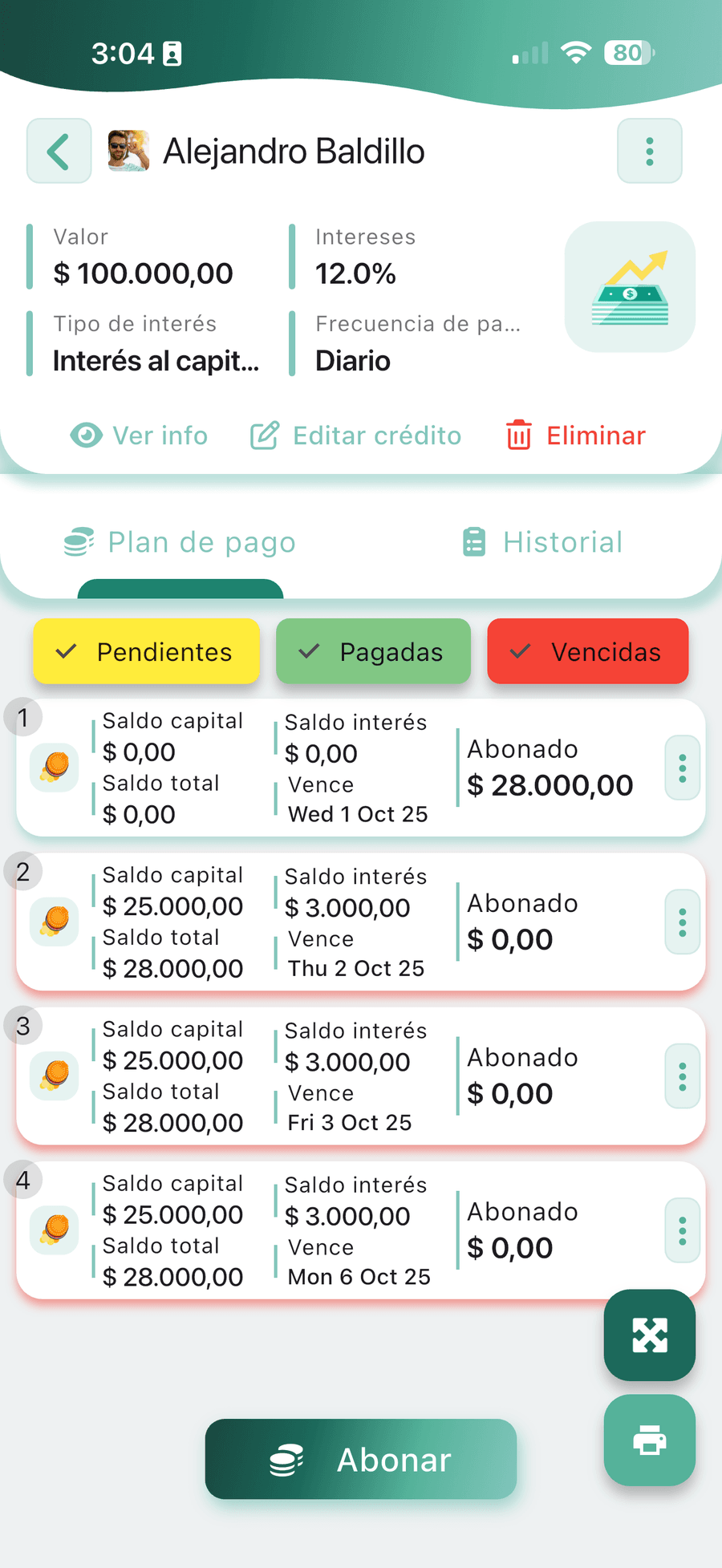
You lend $ 500.000 and charge 20 % on the capital. The interest is $ 100.000 and the customer repays $ 600.000 in total. No mystery so far. The mystery starts when those $ 600.000 have to be split across the days you actually collect.
Because the working day of the gota a gota is not the bank’s. Saturday is a collection day, Sunday is not, and public holidays — which in Colombia move to Monday — shift the whole calendar. A term of 24 working days collecting Monday to Saturday is exactly four weeks; if two Monday holidays fall in between, those two installments move and the loan runs into the fifth week. The collector keeping count in their head no longer knows whether the customer is current or owes two.
CobrApp builds that calendar on its own. You mark the days you do not collect, and the installment that falls on a holiday shifts instead of showing as overdue. If you want to understand the formula before trusting the machine, it is explained in the guide on how to calculate daily interest on a loan.
| Term | Daily installment | How it feels on the street |
|---|---|---|
| 20 working days | $ 30.000 | A little over three weeks collecting Monday to Saturday. |
| 24 working days | $ 25.000 | Exactly four weeks Monday to Saturday, if no holiday falls in between. |
| 30 working days | $ 20.000 | Five weeks. The lowest installment of the three and the longest round. |
And the arrears are just as clear: at $ 25.000 a day, a customer who skips three visits carries $ 75.000. It is not a colored alert, it is the money you are missing to lend to the next person. To keep that count per customer rather than by instinct, look at daily loan tracking.
The route does not wait for the signal to come back
Anyone with a few months on the street has a mental map of the dead spots: the inner corridor of a market, the house at the back of the lot, the stretch of road between two hamlets, the corner where the phone shows full bars and loads nothing. They are not rare exceptions, they are stops on the daily route — and always the customers who have to be collected from no matter what.
With a tool that needs internet to save, those stops end up written by hand to be typed in at night. CobrApp writes to the phone first: the payment, the receipt, the mark for whoever was out and the cash close are all resolved without a single bar. When the phone reconnects — in town, at home, on the office wi-fi — the whole day uploads on its own and is backed up. The mechanism is explained calmly in how offline work and syncing function.
The 58 mm printer you bought in San Andresito
There is no equipment to buy: the app connects over Bluetooth to the portable 58 mm and 80 mm thermal printers sold in San Andresito and in electronics shops across the country. The slip comes out with the date, what the customer handed over, the balance left and how many installments remain. Four pieces of information, and the paper reads standing at the door without needing explanation.
What you gain is not the slip: it is that the account is closed on the spot, in front of the customer, instead of sitting in your notebook to be reviewed three weeks later. And if the printer ran out of charge that day, the payment goes in anyway and the receipt prints later keeping its original date. What a receipt needs to carry to be worth anything is in the guide to professional digital receipts.
PAYMENT RECEIPT
Installment 14 of 24 · $ 25.000
Paid
Printed with no internet
- Pocket portable 58 mm · Bluetooth
- Counter portable 80 mm · Bluetooth
- Out of charge that day prints later, with its own date
Pesos, written the way they are written there
Nobody mentions this and it hurts from day one. A system configured with a foreign format prints an installment of twenty-five thousand pesos as 25,000.00. The customer who gets that paper stares at it: two zeros too many and a comma that means something else there.
In CobrApp the figure comes out as $ 25.000: a dot for thousands and no cents, because the coins to pay them do not circulate on the street. Installments are deliberately kept round — $ 20.000, $ 25.000, $ 30.000 — so the payment is made with one note and nobody has to hand back coins at every door.
The usury ceiling is certified by the Superintendencia Financiera
Colombia has a legal ceiling on interest: the usury rate, certified by the Superintendencia Financiera and updated periodically. We deliberately do not publish it here, because any percentage written on a web page is out of date within weeks. Check the current certification at the official source before deciding what you will charge, and check again every time the period changes.
The app does not decide for you: you configure the percentage you settled on and it does the arithmetic. For the paperwork behind the loan — promissory note, contract, data authorization — look at the legal documents a lender needs and the model simple loan agreement.
CobrApp does not grant credit or lend money. It is a technology platform for collections management and portfolio control of loans issued by third parties.
From one route of your own to several collectors on the street
While you collect alone, the notebook holds. The day a second collector goes out with your money, it stops holding: you no longer know who visited whom or how much really came in. This is what changes when the business passes to several hands, and it comes with the plans that include team members.
- Step 1
Each one sees their own route
The collector signs in with their user and sees only their customers. The full portfolio of the business stays with you.
- Step 2
The cash balances itself
What each collector took in is added up at close. No more counting notes against a crumpled sheet.
- Step 3
Everything exports to Excel
The portfolio and the movements export to Excel or CSV whenever the accountant asks, with nothing to retype.
To order the round by neighborhood before splitting it, look at collection routes; if you manage several collectors’ portfolios, the collections platform shows everything in one dashboard. Just want the street tool and nothing else? That is the debt collection app. The free plan covers 10 customers and 2 loans each; what lies beyond is on plans and pricing.
Questions from collectors in Colombia
What people ask when they collect in pesos, in working days, with the printer in the bag.
How do I track daily collections with an app?
Can I run loans over 20, 24 or 30 working days?
Does it work on the blocks and rural stretches where the signal drops?
Does it work with the thermal printer sold in San Andresito?
Do the figures show in Colombian pesos the way they are written there?
Does the app tell me the maximum rate I can charge?
I have five collectors on the route — can I supervise them from home?
$ 3,470.00 Balanced
What a route of 37 visits with 4 collectors brings in on one day, with the portfolio balanced at close.
Download the app and build your first route tonight
You move over the loans you already have written down, mark the days you do not collect, and the working-day calendar is ready for tomorrow’s round.