
Daily loan tracking: how much you have on the street
Lending is the easy part. The hard part is answering, at six in the afternoon, how much of what is out there is your capital, how much has come back, what you actually earned and which part has been sitting still for days. That is portfolio control, and it does not show in the notebook’s total.
CUSTOMER STATEMENT
Customer A
The four figures that rule a daily-collection portfolio
With daily collection, even a small portfolio racks up hundreds of movements a month: every customer leaves a record per visit. But to know how the business is doing you do not need hundreds of numbers: you need four. If you know them by heart, you have control. If you do not, you are moving money blind.
Capital on the street
The common mistake: Adding up the total receivable. That number includes interest you have not earned yet.
Capital recovered
The common mistake: Counting the whole day’s takings as capital recovered. Part of it is interest.
Interest earned
The common mistake: Treating as earned the interest on installments the customer has not paid yet.
Arrears by age
The common mistake: Looking only at the arrears total, without separating who is two installments behind from who is twenty.
Split an installment in two: capital and interest
A loan of $1,440 at 20% on the capital, spread over 24 daily installments. The interest is $288 and the customer ends up handing over $1,728, so each installment is $72. And that is the point: those $72 are not one thing. They are $60 of your capital coming back ($1,440 ÷ 24) and $12 of interest ($288 ÷ 24).
With 10 installments collected, $720 has come in — which is really $600 of capital recovered and $120 of profit. You still have $840 of your own money out with that customer and $168 of interest yet to be earned.
That split is what changes decisions. The notebook says “they paid me $720”; the portfolio says “you recovered $600 of your capital and earned $120”. And if the customer stops at installment 11, what is at risk is not the $720 that already came in: it is the $840 that has not come back.
The arithmetic changes if the interest is recalculated on the balance instead of on the original capital. It is explained step by step in the guide on how to calculate daily interest on a loan.
The portfolio statement for four customers
Now the same arithmetic, but across the whole portfolio. Four customers, all on the same terms: 20% interest and 24 installments. You can redo every row with a calculator.
| Customer | Lent | Installment | Paid | Collected | Capital recovered | On the street | Behind |
|---|---|---|---|---|---|---|---|
| Customer A | 1,440 | 72 | 10 of 24 | 720 | 600 | 840 | Current |
| Customer B | 480 | 24 | 18 of 24 | 432 | 360 | 120 | Current |
| Customer C | 1,920 | 96 | 6 of 24 | 576 | 480 | 1,440 | 9 installments |
| Customer D | 960 | 48 | 22 of 24 | 1,056 | 880 | 80 | 2 installments |
| Total | 4,800 | 240 | — | 2,784 | 2,320 | 2,480 | — |
You placed $4,800 and have collected $2,784. It sounds like a business doing well, and it is, but the number that matters is another: of those takings, $2,320 is your own capital coming back and $464 is what you earned. And you still have $2,480 out there, more than you have recovered.
The second reading is in the last column. Customer C has $1,440 on the street and nine overdue installments: of the $2,480 that is out there, more than half is with them, and they are the only one with a serious problem. A total of “nine installments” of arrears across four customers says nothing. Knowing they are all with the customer holding the most capital says everything.
And the third: customer D has $80 on the street and two installments behind. That is an irrelevant amount of money, but they are the best candidate to renew when they finish, because they paid 22 of 24 installments without slipping. Portfolio control is not only for collecting: it is for deciding who you lend to again.
Arrears are counted in installments, not months
Bank language does not work here. “One month of arrears” on a monthly loan is one missed installment; on daily collection it is twenty-four. That is why a daily portfolio is classified by overdue installments, and each band calls for a different action.
| Overdue installments | What it means | What to do |
|---|---|---|
| Current | No overdue installment | This is your healthy portfolio. It is what decides whether you can lend tomorrow. |
| 1 to 3 installments | They hit a slow day | Message or call the same day, before the shortfall becomes a habit. |
| 4 to 7 installments | The payment habit has changed | A visit outside the normal route and a written agreement to catch up. |
| 8 to 15 installments | One to three weeks without paying | Renegotiate the payment plan. This is where it freezes: no renewal, no more lending. |
| More than 15 installments | Hard-to-collect portfolio | Separate recovery, with its own follow-up. Stop counting it as active portfolio. |
Classifying this way has an immediate effect: there stop being “customers in arrears” in general and there start being five groups with their own treatment. The portfolio beyond fifteen installments comes out of the active count, because leaving it in inflates your capital on the street with money that no longer turns over. When that block grows, the problem stops being collections and becomes recovery: we explain it in how to manage an overdue portfolio by arrears stage.
What you cannot see in the notebook total
The collector’s cash is not the portfolio
What the collector hands in at night and what they recorded as collected are two different figures until you reconcile them. The difference may be a route expense, a payment recorded twice, or a shortfall. If you only look at the cash, the portfolio is wrong from day one.
Renewals hide the arrears
When you give a new loan to a customer in arrears to clear the old one, the arrears disappear from the paper and the risk stays. Always separate how much of what you placed today was new money and how much was refinancing: without that split, a sick portfolio reads as a healthy one.
Capital on the street is not your net worth
If part of what you lend is money that was lent to you, that liability appears nowhere in the portfolio. Note it separately and subtract it mentally every time you see the total placed. What is yours is the difference.
A customer who is current can also be a risk
The one who pays exactly the installment, never pays extra and renews the moment they finish keeps your capital out there permanently. They are not in arrears, but they never give the money back either. Look at them by capital tied up, not just by days behind.
Three closes that order the week
Daily close
You reconcile what was collected against what each collector handed in and review the visits that came back empty. It is done in one pass, and if it is not done today, tomorrow nobody remembers.
Weekly close
You review the arrears by age and decide who gets renewed, who gets frozen and who needs a visit outside the route. It is the meeting that prevents end-of-month surprises.
Monthly close
You compare capital placed against capital recovered and interest earned. If you place more than you recover month after month the business is growing; if it is the other way round, it is shrinking without you noticing.
How this control works in CobrApp
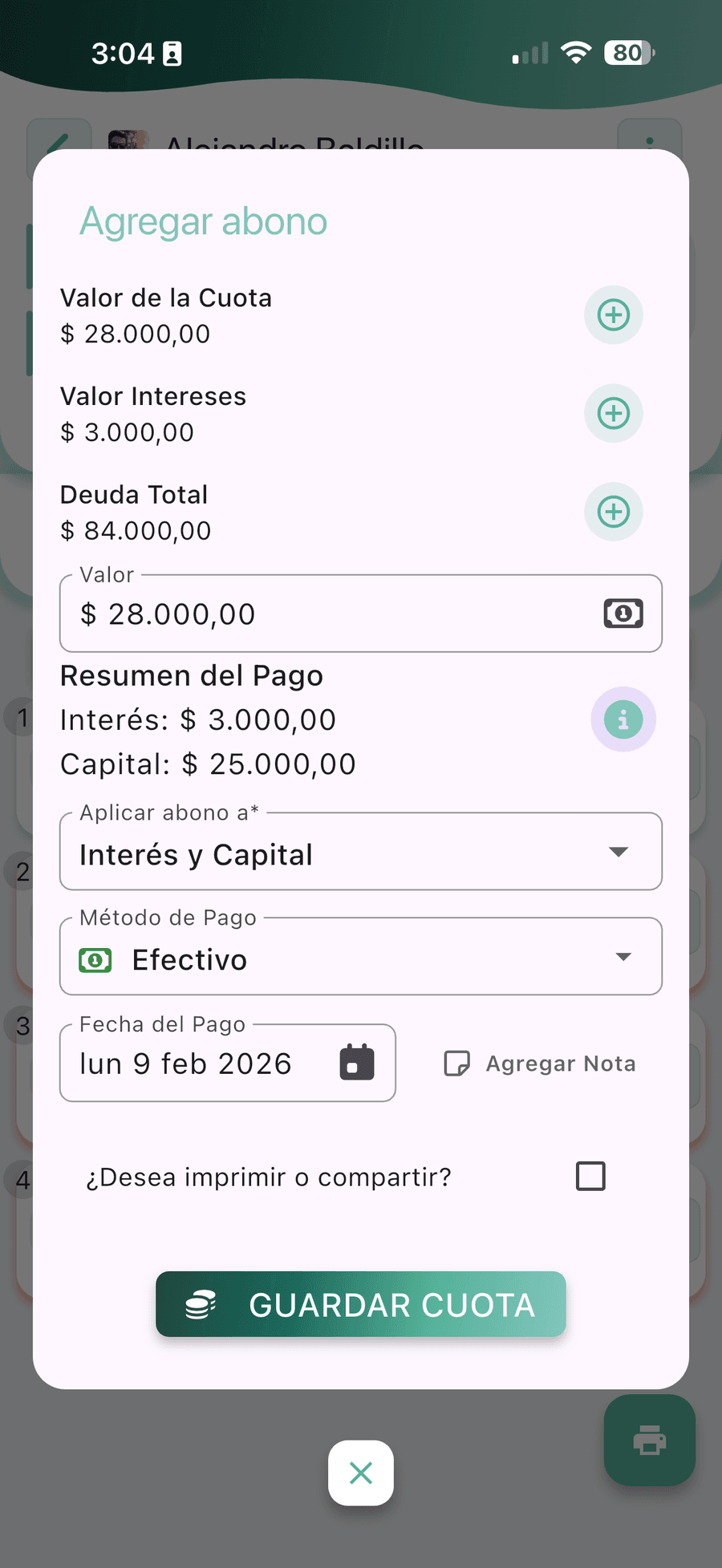
The four figures are not calculated by hand: they come straight out of the movements you already record. Every time you note a payment, the app splits it between capital and interest, updates the customer’s balance and recalculates the capital on the street across the whole portfolio. The day’s close is ready when you finish the route, not two hours later.
Recording works with no internet, which is how collecting actually happens in a neighborhood and in rural areas, and it syncs with cloud backup as soon as the signal returns. You can print the payment receipt on a 58 or 80 mm Bluetooth printer on the spot, and export the portfolio to Excel or CSV when you need to review it calmly or hand it to your accountant.
If you work with team members, each collector sees only their own customers and you see the consolidated portfolio, which is the only way the day’s close balances without arguments. The route itself — areas, visit order, customers per day — is organized separately, in collection routes.
The free plan allows up to 10 customers and 2 loans per customer: enough to try full control with real customers and see whether the way of working suits you. The terms of the paid plans are on plans and pricing.
Coming from another tool? Compare what you lose and what you gain by leaving the collections Excel template, look at the full collections platform, or check the loan management software if what you need is to build the loan and its installment schedule. To go deeper into the recording routine, the guide on how to keep track of your loans and the one on real-time collections metrics work through it step by step.
CobrApp does not grant credit or lend money. It is a technology platform for collections management and portfolio control of loans issued by third parties.
Frequently asked questions about daily loan tracking
What people ask most when they start reading their portfolio instead of their notebook.
How do I keep the books on daily loans with CobrApp?
Does CobrApp work as a daily collection and portfolio-control system?
How do I track customer payments for free with an app?
What is the difference between capital on the street and the receivable balance?
How do I know what I actually earned this month if everything is on the street?
How often should I close the portfolio?
How do I count arrears if the customer pays partially?
$ 3,470.00 Balanced
What a route of 37 visits with 4 collectors brings in on one day, with the portfolio balanced at close.
Know how much you have on the street before you lend again
Register your customers, note the payments and let the portfolio statement build itself. Free to start and works with no internet.
CobrApp does not grant credit or lend money. It is a technology platform for collections management and portfolio control of loans issued by third parties.