
Collect your route in soles, stall by stall and with no signal
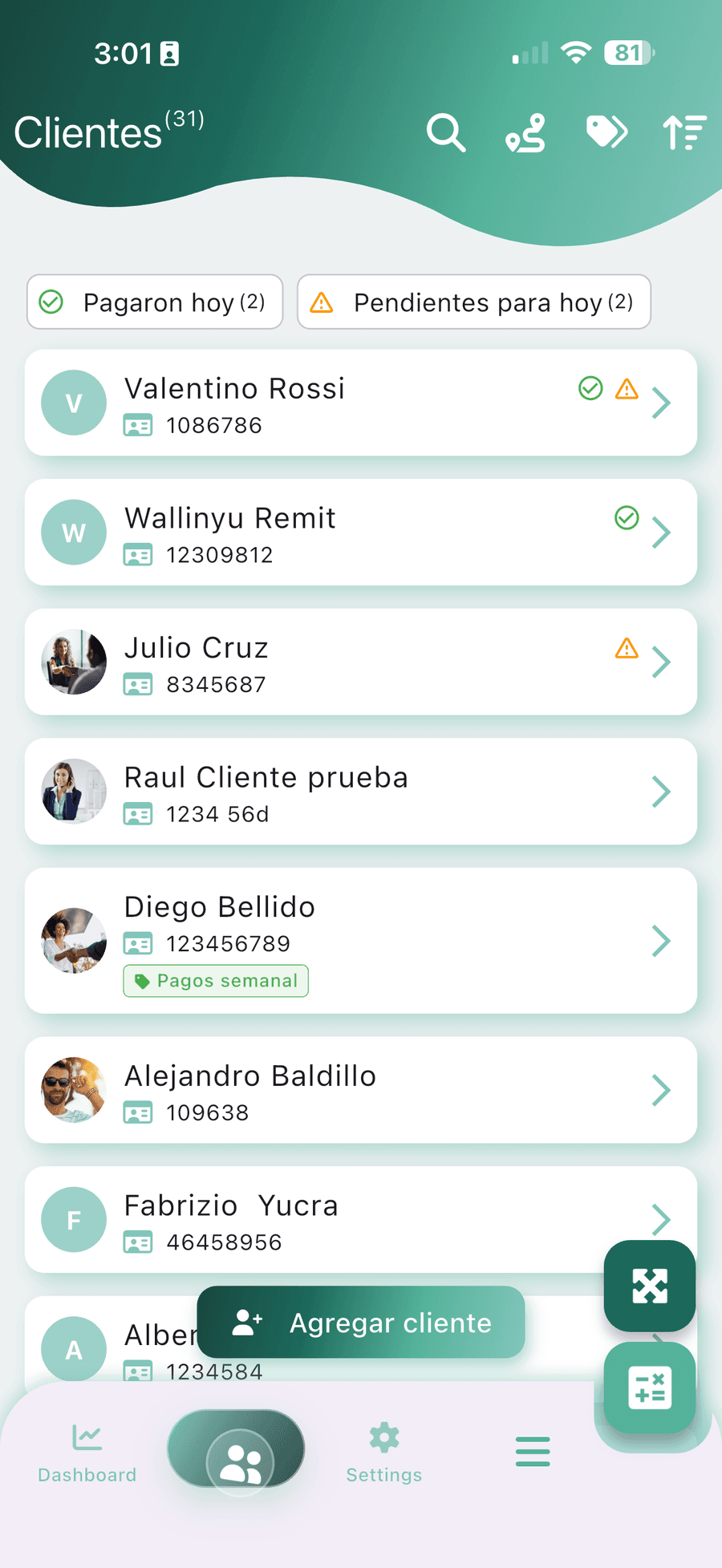
The Peruvian street lender does not collect in an office: they collect in the corridor of a shopping gallery, at the door of a market stall and on the road out to the provinces. CobrApp keeps that portfolio in soles, works out the installment on its own, prints the receipt on the spot and does not shut down when the phone runs out of data.
You start free: 10 customers and 2 loans per customer, no card and no expiry date.
Market credit, city by city
There, the small loan almost always starts at a stall. The grocery owner needs to restock on Monday, the garment maker needs fabric before the season, and the fruit stall needs merchandise today to sell tomorrow. None of them waits for a credit committee: that is why someone delivers the same day and comes back every morning for the installment.
Lima
Multi-storey galleries and stalls packed side by side. You collect walking the corridor, not driving between houses: twenty customers can be on the same block.
Arequipa
Wholesale market and neighborhood commerce. The round starts early, when the merchandise arrives, and you have to be out before the crowds.
Trujillo
Wholesale and retail mixed together. The trader sells all morning and only has the cash together by mid-afternoon.
Cusco
Sales tied to the tourist season. Good months and thin months, so the term gets negotiated more than usual.
That business does not fail for lack of customers: it fails on administration. Five portfolios in your head, a notebook with three months of accounts and the change mixed in with the capital. And in a market a mistake is expensive, because the same corridor where you collect is where the customer tells everyone what happened with you. If you are still setting the business up, how to become a lender and organize your first capital is the starting point.
S/ 1,000.00 at 20 %, spread over 24 installments
It is the loan you see most in a market. Redo it with a pencil: the numbers add up.
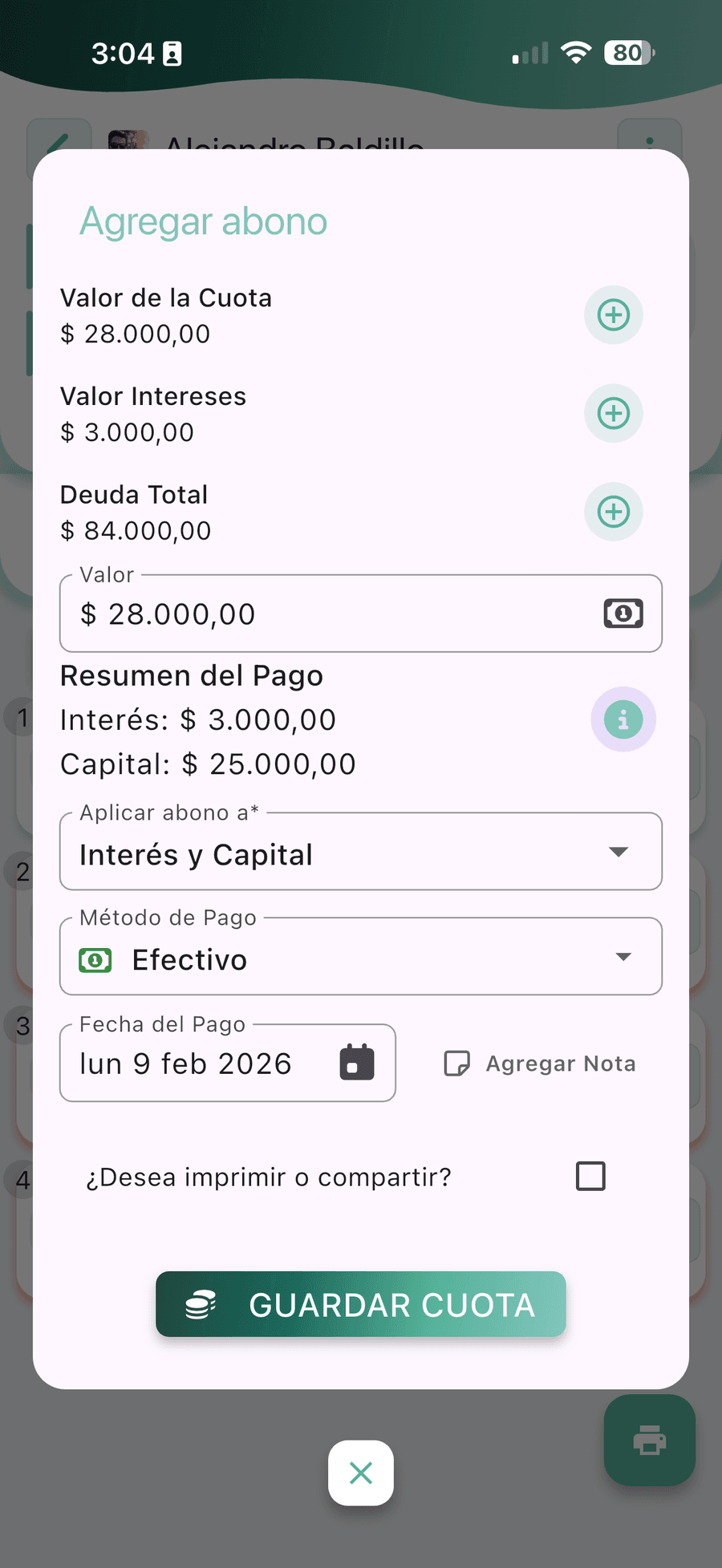
Start at the end, which is how it is agreed at the stall: the trader asks how much they have to leave every morning. The answer there is S/ 50.00. Where it comes from: the capital handed over is S/ 1,000.00, the agreed percentage 20 % — that is S/ 200.00 — and the term, 24 collection days, which is four weeks Monday to Saturday. The S/ 1,200.00 divided by 24 gives the installment. Anyone can do that much on paper.
The trouble starts the next day. On Tuesday the stall does not open. On Thursday the customer pays S/ 30.00 instead of S/ 50.00 because trade was slow. On Saturday they pay double to catch up. Three movements, and whoever keeps the count in their head no longer knows whether that customer is ahead or behind. CobrApp records every payment with its date and recalculates the balance on the spot: the unpaid installment is flagged overdue and keeps weighing on the balance until it is covered.
One detail decides whether the paper is any use: the cents. A round daily installment is the exception, not the rule. With capital of S/ 650.00 at the same percentage and the same term, the installment comes to S/ 32.50, and there the negotiation starts about whether to charge the fraction or adjust the last installment. CobrApp keeps the balance to the cent and writes it in soles, with the S/ symbol in front: what the customer sees on their receipt is the same figure you have on the phone, with no rounding along the way.
If you also run weekly or monthly installments with an amortization table, the formula is explained step by step in how to calculate daily interest on a loan. To see the whole live balance of your business on one dashboard, that is the job of daily loan tracking.
The signal decides whether you can collect or not
A system that lives in the browser works very well in an office in San Isidro and very badly in the corridor of a gallery. And it is not just the highlands: inside Lima there are whole floors where the phone gets nothing. That is why CobrApp saves to the device first and uploads afterwards.
| Where you collect | What happens to the signal | What CobrApp does |
|---|---|---|
| A gallery in central Lima | Second floor or basement: the phone connects at the door and goes silent in the corridor. | The payment is saved on the device. The upload waits until you are back on the street. |
| A big market mid-morning | There is coverage, but with a crowd on the same block the connection crawls. | The balance is calculated on the phone, not on a server. No spinner. |
| A route up into the highlands | Long stretches with no coverage between one village and the next. | You work the whole route with no data and everything uploads together when you return. |
| Collecting on the coast, with a stable network | Good signal along almost the whole round. | Every payment is backed up instantly and visible from the web version. |
Ordering the round is the other thing that saves time and fares: grouping customers by market and by day instead of crossing the city twice. That is developed on the collection routes page, and how each payment is stored and when it uploads, in how offline work and syncing function.
COBRAPP
Payment receipt · 58 mm
Settled
Printed with no signal
- Pocket portable 58 mm · Bluetooth
- Counter portable 80 mm · Bluetooth
- No printer PDF over WhatsApp
Junta, pandero and a loan: alike, but not the same thing
Where there is stall commerce there is usually also a junta — or pandero, depending on the region. A group of traders puts in a fixed amount each week and, by turns, one of them takes the pot. It is rotating savings, not credit: nobody charges interest and it all rests on the group’s trust and the word of whoever organizes it.
That custom explains something useful to you: the Peruvian trader is already used to paying a little at a time, with discipline. Nobody has to teach them the installment. What changes with a loan is that an agreed interest, a term and a balance appear — and somebody has to keep that balance properly.
What this app does not administer
CobrApp does not run juntas or panderos. It does not assign turns, it does not administer the pot and it does not track who collects this week. Saying so plainly stops you downloading the app expecting something it does not do.
What it does administer is the lender’s portfolio: capital handed over, interest, installments, payments and arrears, customer by customer. If individual loans come out of a junta — which is the common case — each participant is entered as a customer with their own payment plan. To see the whole business on one dashboard there is the collections platform.
| Feature | Junta or pandero | Loan |
|---|---|---|
| Rotating savings among several people | — | |
| Turns and a pot | — | |
| Agreed interest | — | |
| A term and a balance someone tracks | — | |
| Installments, payments and arrears, customer by customer | — | |
| Administered by CobrApp | — |
Three things you learn in the corridor
None of them appears in a feature list, and they are what decide whether the app comes along on the round or stays open unused.
The first round is before the customers arrive
You collect once the stall has taken delivery and there is no queue yet. The app has to open and record the payment in seconds, without waiting for anything to load.
With no proof there is no memory
The customer keeps the paper with the date, what they paid and what is left; you keep the same movement in the account. CobrApp prints over Bluetooth on portable 58 and 80 mm thermal printers.
The portfolio cannot leave with whoever walks it
If the person collecting quits, their notebook goes with them and you are left with nothing. When payments are recorded in the business account, the customer’s history survives the change of staff.
Moving the notebook into the app without stopping collecting
Nobody can stop for a week to digitize their portfolio. It is done while you collect, and in this order.
- Step 1
Start with one market, not everything.
Pick the market or gallery you are collecting from tomorrow and load only those customers with their current balance. A small route is entered in one evening and is useful the next day.
- Step 2
Close the same day in both places.
When the round is done, compare what the notebook added up to with what the app did. While the two figures differ, the problem is in the recording, and it is better found with the portfolio still small. When several closes match in a row, the notebook is no longer deciding anything.
- Step 3
Order the round first, add people after.
First group the customers by market and collection day. Only once the operation lives in the app should you give each collector their login and their route. What gets recorded is the payment with its date and time, not the collector’s path on a map: the app does not do that.
- Step 4
Grow when the portfolio asks for it.
The free plan is enough for a starting route; the current figures for the paid plans are on plans and pricing and the change is made from the app itself, with nothing to re-enter. If you also operate outside the country, see how the trade works in daily collections in Colombia or review every feature in the debt collection app.
CobrApp does not grant credit or lend money. It is a technology platform for collections management and portfolio control of loans issued by third parties.
Questions from lenders and collectors in Peru
Soles, coverage, daily installments and collection teams: what we are asked most from Lima, Arequipa, Trujillo and Cusco.
Does CobrApp work in soles and with the format used there?
Does it work for market credit with daily installments Monday to Saturday?
Can I collect with no signal in a gallery or on a provincial route?
Can I administer a junta or a pandero with CobrApp?
I have two collectors in different markets — can I supervise them?
Does the app tell me what rate I can charge in Peru?
How many countries is CobrApp available in?
Does CobrApp work for daily-payment lenders in Colombia, Mexico and Peru?
S/ 1,812.50 Balanced
What a route of 37 visits across three Lima markets and a second round brings in on one day, with the portfolio balanced at close.
Take your Peruvian portfolio on your phone from tomorrow
Download free, load one market and collect with a printed receipt on your next round.
CobrApp does not grant credit or lend money. It is a technology platform for collections management and portfolio control of loans issued by third parties.