
The debt collection app that lasts the whole route: from the first door to closing the cash
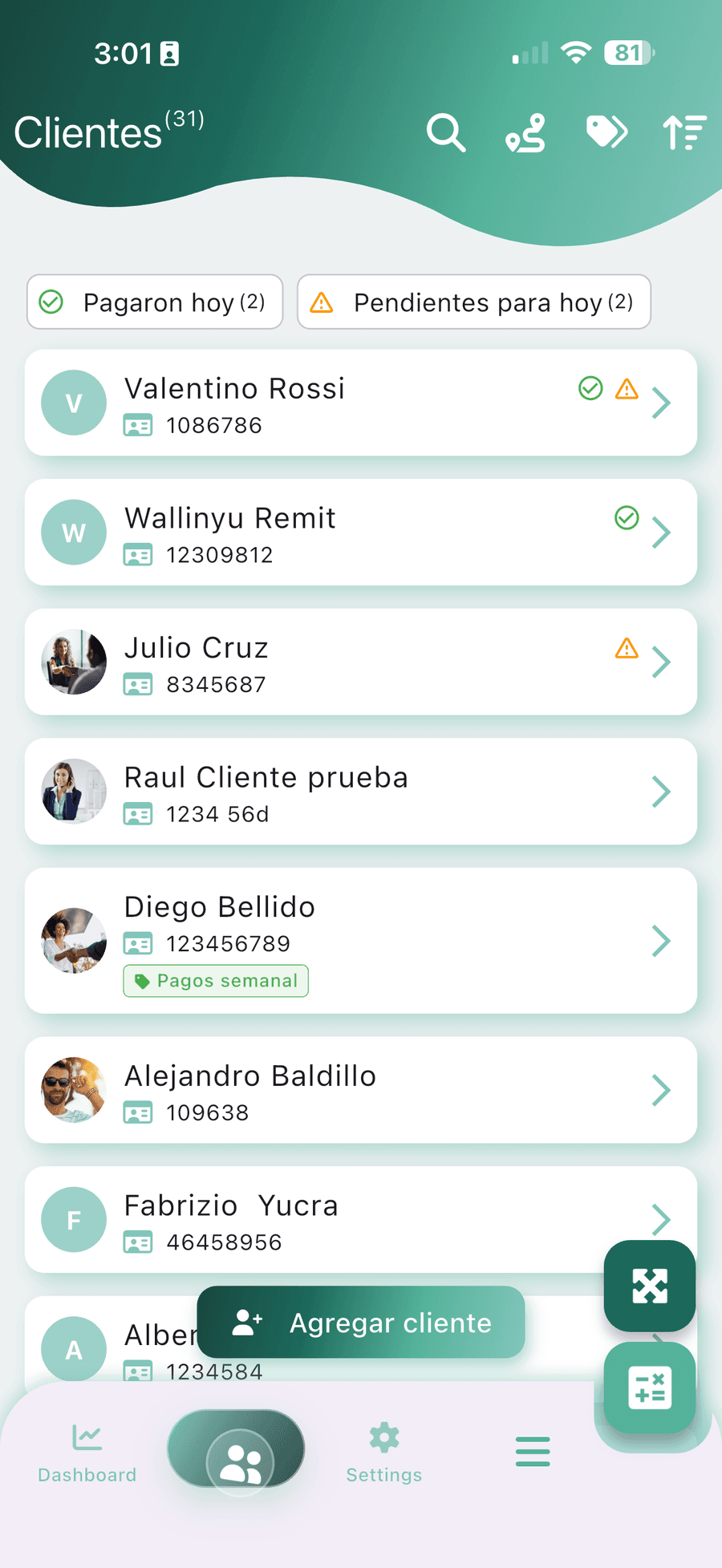
Collecting daily is not opening a program: it is leaving early on the bike, knocking on doors all morning and coming back with the cash balanced. CobrApp is the collector app that follows every hour of that route — including where there is no signal, and including when it rains.
The notebook holds up fine. Until it rains
A field collector does not need anyone to explain the job. They know by heart who pays at seven, who leaves late, who has to be found at the workshop and whose door you do not knock on in front of their spouse. No app replaces that.
What does break is the paper. The notebook gets wet, gets lost, runs out of room on the line of the customer who pays in dribs and drabs, and ends up with three crossings-out on top. And the cash in your pocket does not say whose each note is: you only know that while the route is fresh in your memory.
At the end of the day comes the tiring part: sitting down to add up, subtracting lunch and fuel, setting aside what goes to the capital owner, and finding forty dollars missing that nobody can account for. That reconciliation is where the collector’s profit goes.
A collector app is not going to teach anyone the job. It does the part paper does badly: the arithmetic, the proof of payment, the record that you came by, and the backup in case the phone is lost. If you also run the whole portfolio, daily loan tracking is the other half of the work.
A day on the route with the daily collection app, hour by hour
This is what a normal day of door-to-door collection looks like and what the app does at each point. None of these cases is unusual: they all happen in the same week.
- 6:30 a.m.
You build the route before starting the bike
The app shows who is due today, sorted by area, and keeps the late payers on a separate list. No more flipping page by page through the notebook looking for who is due this Tuesday.
- 7:10 a.m.
First door: the payment is recorded right there
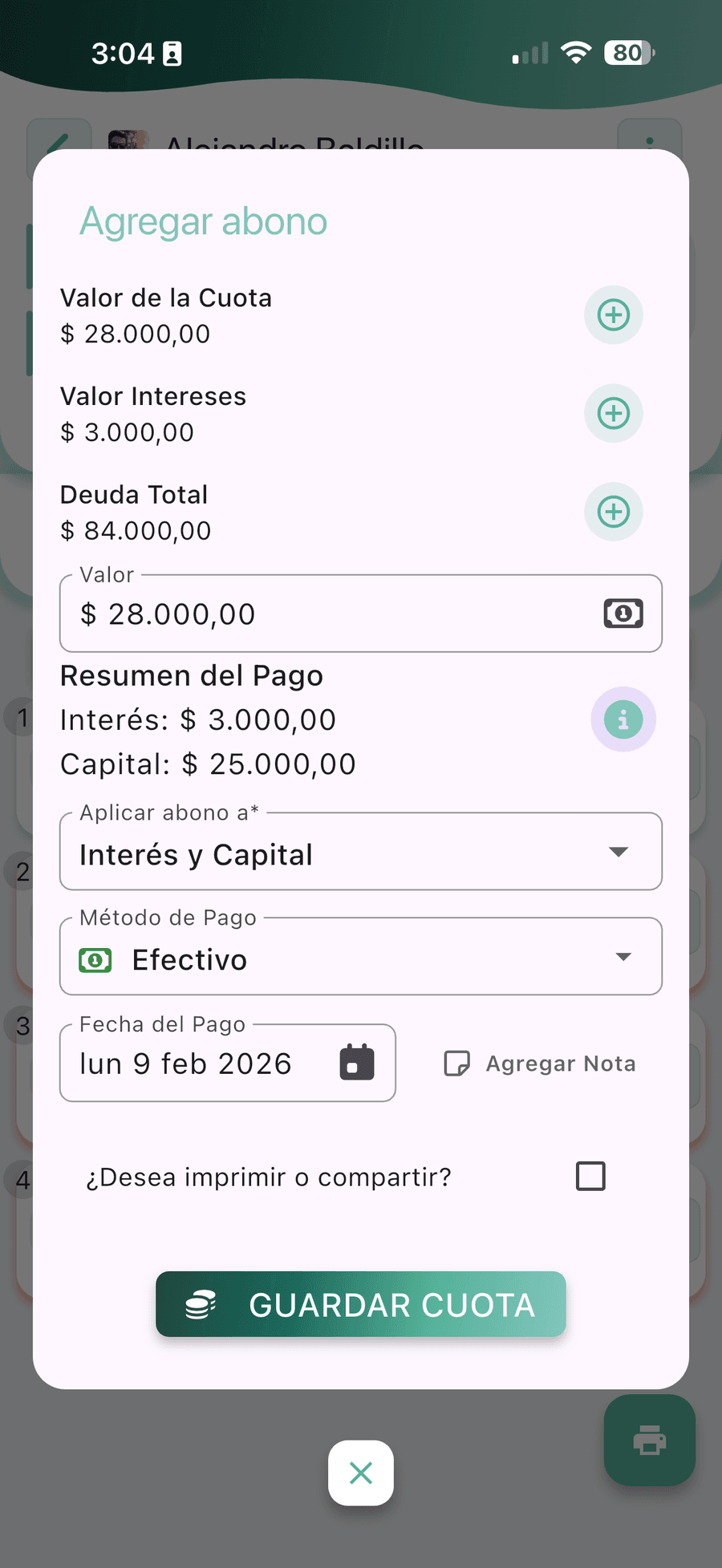
You find the customer, type the amount and confirm without moving from the doorway. The balance recalculates itself while you put the cash away. If the customer wants paper, the 58 or 80 mm Bluetooth printer in your bag produces the receipt on the spot.
- 8:40 a.m.
You go down to the lower part of the neighborhood and the signal drops
Nothing changes. The app works fully offline: you keep collecting, printing and recording. When the data comes back, everything uploads to the cloud on its own without touching a button.
- 9:30 a.m.
The customer is not home
In the notebook that line stays blank and a month later nobody remembers why. Here the day passes with no payment recorded and the customer shows up tomorrow on the late list, with the date of the last payment that did come in.
- 10:15 a.m.
They pay less than they owe
You take whatever they bring. The app splits the installment: it records what came in, keeps the shortfall attached to that same installment and adds the difference to the next day. No subtraction on the street and nothing left to memory.
- 12:00 noon
The downpour starts
A wet page smears and some lines can no longer be read. What you already recorded on the phone is saved and backed up. You take shelter, carry on when it clears, and you did not lose a single payment.
- 2:30 p.m.
One pays double to get ahead
You record the full amount and the app distributes it: it covers today’s installment, applies the next one and moves the payment plan along. The customer is current for two days and the receipt says so.
- 4:00 p.m.
Another one skipped yesterday
The overdue installment does not disappear: it stays flagged and carries over, so today they owe two. The app tells you the exact amount to bring them current, with no argument at the door.
- 6:00 p.m.
Closing the cash: the notes against the screen
You count the notes and compare them with the day’s total on the app. If there is a surplus or a shortfall, you see customer by customer where the difference came from, instead of redoing the whole route’s arithmetic.
The three calculations that break on the street
Redo this with a pencil if you like: a loan of $800 at 20% over 20 installments. The customer repays $960 and the daily installment comes to $48. Anyone can do that in their head. What breaks is what comes next, because the real day almost never matches the payment plan. All three cases below start on the very first collection day.
They pay less. They bring $28 instead of $48. The app records the payment, leaves $20 outstanding on that installment and the balance moves to $932. Tomorrow it shows you what they owe to be current, without you having to remember the shortfall.
They pay double. They hand over $96 because work came in. The app applies both installments, leaves the balance at $864 and 18 remain. The payment plan moves along by itself and the receipt says so clearly.
They skip a day. No payment. That installment is flagged overdue and carries over: tomorrow they owe $96 to get back on plan. The argument at the door ends when you show them the screen with the dates.
None of the three is a maths problem: it is a memory problem at five in the afternoon, with the whole route behind you and the cash jumbled in your pocket. If you want the whole business model, read the guide on what a daily-payment loan is.
CobrApp does not grant credit or lend money. It is a technology platform for collections management and portfolio control of loans issued by third parties.
COBRAPP
Partial payment · printed at the door
What only the person walking the route knows
These are the seven things that actually happen in a week of collecting. On the left, how paper handles them. On the right, what the collector app does.
| On the street | With the notebook | With CobrApp |
|---|---|---|
| It rains mid-route | The ink smears and some lines are unreadable | What you recorded is already saved and backed up |
| The area has no signal | The notebook does not need one, but it does not calculate either | Collects offline and syncs when data comes back |
| The customer swears they paid | You have to find the line from three weeks ago | History with date, time and receipt for every payment |
| The notebook is lost or soaked | The whole portfolio is gone | You sign in on another device and the portfolio is intact |
| They pay less than due | It gets noted in the margin and forgotten | The shortfall stays attached to the installment and carries over |
| Another collector joins the route | You have to photocopy pages | You assign customers and they see only theirs |
| The customer asks for proof | A receipt book, if you brought it | Receipt printed over Bluetooth or a PDF |
The receipt deserves its own paragraph: paper in the hand is what ends the disputes. That is why the app prints over Bluetooth on 58 and 80 mm thermal printers, the kind sold in any electronics shop. And when you collect from someone who is not home, you keep the PDF to send through whatever channel you already use with them. There is more detail in the guide to digital collection receipts.
No signal, no battery, no excuses
An app that needs internet to save the payment fails exactly where the collector works: the hillside, the dirt road, the market basement, the town where a single bar of signal gets through. CobrApp saves everything on the phone itself and syncs to the cloud when the connection returns, so you can work the whole route with data switched off and review it afterwards.
That also means the app does not slow down waiting for the internet: the payment is saved on the spot, in front of the customer. It is explained in depth in the article on collecting with no internet and syncing later.
The other real fear is losing the phone. With the notebook, losing it means losing the portfolio. Here you sign in with your account on a borrowed device and the customers, balances and payment history come back — including the ones you recorded with no signal.
And if you prefer to close the day sitting down, you sign in from the computer browser with that same account: it is for reviewing the week, printing, and exporting the portfolio to Excel or CSV when the accountant or the capital owner asks for numbers.
When the route is no longer one person’s
The old problem of the trade
There comes a point where the collector stops walking the whole route and brings someone else in. That is when the old problem of the trade shows up: knowing what the assistant actually collected and whether they handed over everything that was put in their hand.
Their own login, and a signed payment
In CobrApp the assistant works with their own login and only sees the part of the portfolio you handed them: the rest of the business stays out of view. Every payment is signed with their name, the date and the time it was recorded, so at close you compare what is in the app with the cash they hand you and the difference stops being one person’s word against another’s. What the app does not do yet is follow their route on a map: location supervision is in development, and what gets recorded today is the payment, not the path.
Split the route, or watch the dashboard
To split the work by neighborhood without overlapping areas, look at how collection routes are built and the guide on how to plan collection routes. And if what you need is no longer the route but the business dashboard, with the portfolio and the arrears seen from above, that is the job of the collections platform.
You start free
You start free: the free plan covers up to 10 customers and 2 loans per customer, enough to test the app end to end with real customers. When the portfolio grows, CobrApp’s plans open up unlimited customers, several collectors and cloud backup. Always download from the official download page: modified APKs get no updates and put your customers’ data at risk.
Collector questions about the app
What people already working a route ask when they want to move the notebook onto the phone.
What does a professional collector app need?
How do I use an app to collect money from customers on my phone?
Can CobrApp improve how my collection team performs?
Does CobrApp work as a mobile collections app for a team out on the street?
What should a collections app for a daily-payment business have?
What does a daily collector do, and how does CobrApp help?
What is a daily-payment collections app and how does CobrApp fit?
$ 3,470.00 Balanced
What a route of 37 visits with 4 collectors brings in on one day, with the portfolio balanced at close.
Work tomorrow’s route with the app
Download it today, load your customers tonight and go out to collect tomorrow with the phone in your pocket.
CobrApp does not grant credit or lend money. It is a technology platform for collections management and portfolio control of loans issued by third parties.